Obsessive Disclaiming Disorder in email communication

If I don’t know what you’re thinking, I know what you should be thinking: This is 1999, and you’re reading an article mistakenly dated twenty years hence. But unfortunately, despite our developmental blindness to them — together with their invisibility within the legal system — the pestilence of email disclaimers really does continue to menace perfectly sufficient signatures. Indeed, the contagion looks set to outlive polio.

A recent post in my LinkedIn feed referenced an email from HMRC with a 17-word message, and a 493-word disclaimer. Admittedly, HMRC’s a soft target for purported battiness, but it’s far from alone in practising a rite that might have excused itself from the digital party, in quiet embarrassment, two decades ago.

The eccentricity is now into postgraduate age and, despite a generation of public abuse and humiliation — without chalking up a single precedent of legal efficacy — looks set to endure. It’s a small mercy that these textual tumours remain an email-centric phenomenon, but the same fact serves to heighten their absurdity.

The disclaimer still has something of a spring in its step; it certainly outpaces contemporary human evolution in its generational diversity. Like a Heston Blumenthal chip, there’s always room for improvement; there’s always a legal chef willing to bear the challenge of pursuing it, and always a quavering executive, or government mandarin, with an appetite for garrulous legalese in lieu of actual risk assessment. 

Western visitors to Korea are often baffled and amused by lingering anxieties over the risks posed by… electric fans. Not, you might think, the risk of a child squeezing a tiny finger through the mesh and losing it to a high-speed rotational blade. But the risk that, if inadvisedly left on overnight in a closed room, it might be the end of you. 

Some say its fatal mechanism is hypothermia; others say hyperthermia; others, still, suggest an increase in carbon dioxide concentration. Scientists, I mean. Yes, it’s a subject that’s still a worthy topic for research funding. Government warnings are intended to reduce the risk, particularly during the summer months. In the meantime, newspaper reports dovetail with parochial rumours: ‘Man, 88, mysteriously found dead at home. Coroner’s report inconclusive. A neighbour discovered the body. A fan was reportedly left on in the room.’ Or something to that effect.

Bible readers shouldn’t underestimate the entertainment value of the speck in your brother’s eye. But, getting back to the beam in our own: Through no greater lens than the email has the employer looked upon its employees so inexplicably askance. Why doesn’t HMRC consider it similarly judicious to post a 493-word letter after closing a phone call? Why are businesses so insouciant about leaves of blank headed paper lying around the office, yet clamour for legal counsel in trembling voices when an employee hits New Message in Outlook? Why don’t they legally vaccinate their text messages?

Unparalleled in its ability to stir atavistic fears of institutional misrepresentation, only email must be chastened by these mystical incantations. While organisations continue to rabidly communicate unguarded through platforms old and new — from telephone calls, meetings, and text messages, through to Google Hangouts, Slack, and Facebook Workplace — many continue to cower in foreboding at the thought of transmitting an email without a prayer of protection.

The Enlightenment was supposed to present an existential threat to superstition, not merely to trade its mechanism from the spirit world to industry. The scourge of email disclaimers is, after all, only a marginally more benign indictment upon human rationality than trial by ordeal. What other flavours of callow groupthink, and contemptibly blind imitation, haunt the meeting rooms of our nation’s commercial and governmental institutions?

China is a cultural equal, not a student for moral instruction

The title of Gideon Rachman’s Financial Times op-ed, Xi Jinping faces his moment of truth in Hong Kong, is undoubtedly as much aspiration as observation, such is the English-language media’s ideological commitment to denouncing the Chinese system of government.

Colonisation by force to support an illicit drugs trade contributed confoundingly to Hong Kong’s wealth and standing today; but the willingness to forgive and forget our own inscrutable lack of political probity is seldom extended to our competitors in global affairs. Raising millions out of poverty is ‘whataboutery’ if you’re an unloved regime, whilst moral ambiguity in our own policy record seldom prohibits the end from justifying the means.

GDP per capita in mainland China has seen startling growth over the past decade, but remains modest; and there are 1.5bn citizens to provide with security, healthcare, social services, and retirement income — all of which will be more important to them than the media circus of a western election. Perhaps the political innovations of the self-styled free world have something to contribute to that project; perhaps they don’t. Ultimately, it’s for China, and its citizens, to decide.

Foreign observers should chasten their assumptions regarding the extent to which Hong Kong activists’ democratic principles align them against the politics of the motherland. Popular support for one country, two systems, isn’t a strategic compromise for near-independence; citizens of Hong Kong don’t share with their international supporters such a unifying consensus that Xi-ism is fatally flawed.

To the extent that western democratic principles are encoded in the Basic Law, as part of the handover, or remain a broader source of inspiration, there is a soft power in play. That will have to suffice. Supporting activists as a vehicle to frame media narratives around Xi, in terms marked with interminable calumny, suggests a goal other than analysis — and one that risks needlessly extending to the western grassroots the antipathy currently felt by the most hawkish among their leaders towards a credible competitor.

Self-congratulatory narratives in the west help people forget that all governments rule ultimately by consent; and, indeed, varying degrees of authoritarianism are afforded acts in every nation’s founding story — very often the most celebrated ones. It’s right to advocate for suppressed minorities in China, but American observers, by example, might have the humility to recall that the same year the nation was listening to the Beach Boys’ Surfing’ U.S.A., the Governor of Alabama was blocking three African American students from enrolling in a white school. If we’re to embrace that history as part of a process, why the absence of a process that’s permitted to other nations without the cost of moral invalidation?

The columnists and readers maligning the Chinese system of government in putative solidarity with its oppressed subjects in Xinjiang, or on the streets of Hong Kong, may find themselves on the right side of the moral divide more by an accident of their rhetoric, than by its true purpose; better known abroad than our political freedoms is our proclivity to use the language of social justice as a Trojan horse for proclaiming ideological superiority. The avoidance of truly civilisational conflict with a resurgent China will rest, in this nascent phase, on the willingness of European civilisations to cut the didactic bullshit, and treat the emerging superpower as a genuine cultural equal.

Has liberalism outlived its purpose?

Vladimir Putin’s right, in his illuminating interview with the Financial Times last month, to present Donald Trump as more symptom than cause in changes to the political tide. But, whilst there’s a clarity and candour to Putin’s suggestion that the benefits of globalisation in the US have accrued exclusively to the population’s moneyed margins, it’s inadequate alone as a truly generalised account for the growth of populism elsewhere.

Despite broadly favourable outcomes in recent European elections, nativist discourse is in unquestionable ascent beyond the US. From advanced Anglo-Saxon economies with growing inequity in wealth distribution, through impoverished states in South Asia facing food and water insecurity, and on to the social democratic utopias of Northern Europe, with their advanced education systems and cradle-to-grave welfare states, various brands of nationalism are powering through the electoral gears.

The 21st Century strongmen bear limited resemblance to their 20th Century postwar forebears: rather than the top-down imposition of autocracy on a suffering population — through homegrown coup d’état, or one engineered by cynical Nixon Doctrine alliance — the new generation of aspiring dictators is being ushered in from the bottom-up by a global constituency of nativist tribes, increasingly fervent to delineate themselves from one other, and doing so in comically similar language.

The insidious polarisation of grassroots populations threatens a truly global liberal order more than the actions of the cartoon villains they elect. The issues by which people choose to identify themselves are cleaving the body politic in two; while working class nativists and middle class metropolitans compete over attendance numbers at street protests, the allied polemicists of each gather on both sides of the debate and do little to advance it. The internationalists are trapped in a fruitless cycle of exposing populist non sequiturs, blind to the fact that the movement’s adherents had started with the conclusion and worked their way back to the reason.

Hope rests on the return of real politics: informing voters, and persuading them. Eisenhower’s valedictory address referenced the threat of the incipient and cynical alliance between business, the military, and government; the new threat is the subsumption of politics into the public relations and marketing industry of the digital era.

Electioneering now involves merely canvassing public opinion, and then navigating it. The old guard of mainstream corporate media points to the threat of Russian interference, over-reading a minor subplot in a greater odyssey: Politics by the fissile materials of audience segmentation, and the related innovations in marketing intelligence of the digital age, reveal and reinforce the ideological fault lines in the population; the socially radioactive effluence of populism is the true cost of the method.

North Korea is not the only unpredictable partner in the world’s most contentious rapprochement

What will the US promise in return for disarmament? How far can the US be trusted to deliver on those promises? How resilient would any US concession be to a change in administration?

Observers wishing to take their cynicism seriously — over the world’s most contentious rapprochement — will have to read beyond the headlines, which instead focus exclusively on North Korea’s history of duplicity and lapsed promises.

It’s unlikely to be lost on the North Korean team that US foreign policy orthodoxy holds the status quo on the Korean Peninsula to best serve its interests. Behind Trump’s entertainingly vainglorious diplomatic grandstanding is a foreign policy establishment manoeuvring to relieve North Korea of its nuclear armaments — without permitting its allies to consider the pariah state no longer a threat.

Peaceful reunification of the Korean Peninsula being in the western alliance’s best interests is the logical conclusion of the propaganda, not the politics. In addition to exposing the Pacific Rim to the greatest of evils for economic planning — political change — a unified peninsula liquidates a key asset in the US’s regional investments: its diplomatic pretext for regional military deployments that are more likely apropos of China. US ambitions of continued power projection in the Pacific risk being frustrated by significant changes in Korean politics; indeed, there’s a material possibility of a unified Korea falling entirely outside of the US sphere of influence, given that China is already the principal trading partner both North and South of the 38th parallel.

Trump’s perception of the North Korean nuclear problem, as one that might be solved by a deal, is exposed to being overturned by a future administration that’s more compliant with established foreign policy wisdom. How readily I can imagine nuclear disarmament being later described as only one phase of the reforms required to normalise relations and maintain sanctions relief: that free and fair elections must follow, or military exercises will resume. And, all the while, Kim’s efforts to cry double standards over tolerance of, say, Saudi Arabian autocracy, will be lost in a cacophony of throat-clearing and sententious platitudes by the inexplicably compliant media over here in the free world.

North Korea might play with its promises. But the degree to which it does so may derive from the degree to which we, the western alliance, play with ours.

Anti-Semitism & the Labour Party

People seem to be very tribal. Travelling the world, it’s hard not to conclude that they’re almost all racist. Not necessarily vindictively so, but often even that. Even among the swelling ranks of Corbyn supporters, denouncing straw-man Conservatives for intolerance and xenophobia, it’s not uncommon to find surprisingly ethnically homogenous friendship groups, and a tendency to avoid substantive conversation — or, even, eye contact — when faced with someone speaking English as a second language.

For much of European history, Jewish communities were a major — if not the principal — target for racism. They’re not any more. They’re certainly not in the UK. Members of the white British Generation X know exactly whom the most nationalist, bigoted, and isolationist elements of society have goaded each other to tease, bully, deprecate, or tyrannise over the past thirty or forty years. And the targets are all more recent immigrant communities.

It’s not everything, but it’s not nothing, for me to say that at school through the 1980s and 1990s, I happily don’t recall a single incident of Jewish schoolfriends being a target for racism. By contrast, then and since, I can’t begin to recall the number of incidents that have left me winded over racism targeted at South Asian, Afro-Caribbean, or East Asian friends, partners, or even strangers.

In the South East of England, I had a harder time for being thin than my Jewish friends had for being Jewish. Other friends had a way harder time for having acne, or for being gay. Without doubt, experiences would have been different, and worse, for Jewish children living in more culturally homogenous enclaves, geographically adjacent to — but socially detached from — other British communities. Mine is an idiosyncratic account but, being the direct experience of over 40 years in provincial England, one that is hard for me to completely dismiss as a test of attitudes outside of particular regional flashpoints.

That there is a specifically anti-Jewish racism penetrating the UK body politic — something different to the racism that depressingly menaces relations between all communities — is a notion I’ve not experienced. That, I must emphatically convey, is not to claim that the crime has not been committed, but rather a confession that I can’t offer myself as witness to it.

That this particular strain of social pathology in endemic within the Labour Party membership — to an order that almost defines it demographically against the Conservative Party membership — seems an even more eccentric idea. It is, at best, a happily anachronistic anxiety. At worst, it’s a political device.

Many of us grew up with no axe to grind in the Middle East, had uninformed parents that were unable to make head nor tail of Middle East politics, and a mainstream media narrative that attributed the woes in Israel to a terrorist called Yasser Arafat, who hijacked planes, bombed civilians, and cackled at his victims’ demise like a cartoon villain.

Those of us that went on to discover that the region had a somewhat more complex past and present, unwittingly also went on to discover a second expanse of unchartered territory: that is, being on the receiving end of accusations of racism. Except not for the name-calling, teasing, or bullying that we’d witnessed on racial lines at school, but: for publicly demurring over Israeli government policy.

A surprising number of people support security policies in Israel that are so dramatically deleterious to Palestinian civic life that they would be unconscionable in Britain. And yet to criticise those policies, with no agenda beyond challenging a friendly nation to manage criminality with more civility, can put you in a uniquely invidious position. Protesting against issues such as ‘detention without trial’ — uncontroversial if levelled at, say, North Korea — weaves you into a discursive tapestry that, by merely following the path of your conscience, can leave you depicted as the xenophobe.

Ever present in this ethical and political labyrinth is the shadow of the Holocaust, and it’s easy to appreciate why. But the unprecedented, industrial scale of human suffering inflicted upon European Jewry less than a hundred years ago is not, first and foremost, a Jewish tragedy: it’s a human tragedy. Any greater ethnolinguistic affiliation I might have with the British prisoners of war working on the Burma Railway, than I do with Jewish families summarily murdered in Eastern European death camps, counts for nothing when reflecting on their fate. They’re all my cousins, and the horrors they endured rank equal to me — in empathy, in sorrow, in opprobrium, and in fact.

Any other view would be a benign version of the ethnic, cultural, or religious exceptionalism that, in its most malignant form, mandated the atrocities in the first place.

Ethnocentric fascists in the early 20th Century framed, and then blamed, ‘other people’ for society’s problems in an act of political expediency that won them a mandate, at the cost of millions slain. Each time lobbyists invoke pejoratives reserved for those ideologues — purveyors of among the most evil doctrines ever to have terrorised humanity — to institutions as benign as the modern-day Labour Party, another pillar of the history’s potency collapses.

The misuse of history’s most important lessons by the most conservative elements of Israel’s political defenders, in order to silence its most vocal critics, is squandering one of the most valuable pedagogical assets that humanity owes posterity.

Illustration © 2017 Rikki Hewitt

War Games on the Korean Peninsula

There’s a wealth of critical histories of the lives of British subjects during the colonial era. But if any of those histories presents a narrative that suggests the colonial system was primarily an abuse of power, an agent for rapacious politics and economics — or that the empire might have imposed itself upon its subjects at their exclusive cost, for the exclusive benefit of the imperial haute monde — it quickly becomes the subject of controversy. Niall Ferguson fumbles for his mobile to answer a Radio 4 producer, and gets ready for an early morning huff on the Today Programme, applauded by terraces of readers, fans, or otherwise indignant, besmirched listeners.

At the root of their rancour is, essentially, the assumption that the end justifies the means — be that proverbial end either: (a) railways; (b) a globalised economy; (c) political institutions; or (d) some other bequest sufficiently dignified or sexy to warrant trans-generational gratitude.

My principal contention with their contention is not ideological but, rather, the enduring lack of consistency. We see it each time the same constituency unites in a chorus of antipathy towards our political enemies. Reflecting on their own totalitarian past, they celebrate it, boast about it, eulogise and dramatise its most violent proponents, recreate and reminisce in endless lavish dramas for stage and screen, and neutralise its political toxicity by presenting it as an essential part of a process.

A process that, it’s claimed, led via Magna Carta, the Provisions of Oxford, and the Bill of Rights, to parliamentary democracy and, ultimately, to universal suffrage.

Faced with the Edwards of their political enemies, however, they pity their system, malign its beneficiaries, and advocate for its victims: first in sententious rhetoric, and later by bombing them.

Contrast, for example, mainstream opinion over the Kim family’s culpability for the North Korean famine with the same constituency’s opinion over the British Government’s culpability for the Bengal famine or, closer to home, the Irish famine. Most interesting is when you garner that opinion from those who openly confess to knowing very little about either. Try it at home! We’re peculiarly, and reliably, more tolerant of our own totalitarianism than others’.

Whilst making sense of whether we’re in the throws of a 21st Century Cuban Missile Crisis, it’s easy for amnesia to set in, in regard to how little we know about life in North Korea. The most interesting insights have been those that have challenged the western public’s received wisdom — with photos of normal people going about their lives in Pyongyang, candid photos of families playing at seaside resorts, or accounts of restaurant and market life on the Vladivostok border. As the growing montage of images of Pyongyang increasingly dispels visions of the dilapidated, Soviet-era basket-case city imagined by the western public, so the story grows of a city reserved for the privileged elite. Aren’t all cities?

North Korea is now, unambiguously, a nuclear state — so any ambitions, strategies, and actions based around preventing that outcome have failed, and US foreign policy must now be reframed. If there was ever a state for which ‘nuclear deterrent’ wasn’t simply a euphemism, it’s North Korea. Now with three children, Kim’s primary concern will be the continuation of his dynasty, which he well knows will end the day he invades his neighbours. So he will not. If a future smoking gun that triggered World War III on the Korean peninsula has North Korean fingerprints on it, they were put there by the PR agents of Kim’s enemies.

Left alone, the sociopolitical environment in North Korea will evolve, like it will everywhere else. Commentators and policymakers committed to the analysis that  holds that we mustn’t sit idle while North Korean citizens suffer — but must instead be ever-prepared to send our children to kill theirs — are part of the problem both here and there.

When the informational landscape is so sparse, as it is with North Korea, we should be suspicious when the public discourse is filled with more answers than questions. To some, North Korea may be intolerable; to some, it may simply be home; to others, it may be a source of pride. We could say the same of our contemporaries from Edwardian England. And perhaps Song China might have looked on in pity for England’s 13th Century peasants, and mused intervention with their greater social, political, and technological sophistication. How kindly do readers think imperialist Chinese warrior-philanthropists might have been received by England’s Plantagenet subjects?

Through our cultural lens, the dress, style, language, and tone of North Korea is one-dimensional, tyrannical, eccentric, absurd. North Korea continues to fulfil the stereotype of the Cold War Bond villain. Trump says, in opposition to the new South Korean president’s nascent policy of appeasement, that there’s only one thing that the North Koreans understand — one of the few Trumpian claims considered uncontroversial by the wider public. But, in its anxiety to survive, North Korean policy has exposed the bitter irony of that premise. In the superpower’s unwillingness to relinquish its monopoly on power in the Pacific, there’s only one language that US foreign policy understands. And, with a nuclear deterrent, Kim’s speaking it fluently.

‘Enough is Enough’

Beyond the immediate violence and horror of a terrorist attack, and its wider fallout, the last of its victims is always perspective. It’s designed to be.

For the desperately unfortunate minority directly affected by heinous acts of violence, that perspective might reasonably be unrecoverable. For the more fortunate majority, it’s essential it never slips from our grasp.

It seems that the sub-cerebral response of an alarming range of political figures—if someone’s stabbed, bombed, or shot by some petty criminal-turned suicidal zealot—is to ramp-up public surveillance, erode civil liberties, dismantle civil protections within the criminal justice system, rant about ‘cowardly acts’, and anthropomorphise cities.

I’m unclear whether that’s because certain policymakers perceive an opportunity in the lack of public perspective, or whether they simply lack perspective themselves. In either case, what’s even more worrying is that the public seems to be in a growing state of consensus with them — if not emulation.

Usefully, The Telegraph on Sunday cited some figures from the Global Terrorism Database, which are altogether more helpful than HM Government’s public statements for making sense of recent chaos:

UK Deaths Owing To Terrorism

15-year period Number of Deaths
2000-2015 90
1985-1999 1,094
1970-1984 2,211

To add further perspective, I looked up the Office for National Statistics’ figures on UK homicides, which record 518 murders in the UK in the year ending March, 2015. Of these, 186 victims were women, of which 82 were murdered by their partner or ex-partner. That was, continuing a decade-long trend, the lowest number of homicides in ten years.

So:

  • 2015 saw the lowest number of UK homicides in the late modern era.
  • In 2015, 82 women were murdered by their partner or ex-partner.
  • In the 15 years from 2000-2015, 90 people were murdered in terrorist incidents.

If it’s a question of quantum, heterosexual relationships appear to be a greater threat to public safety than extremist Islam, by a factor of 15.

Shouldn’t we be affording crimes of passion 15 times the disapprobation than we afford a crime of terror? Has the heterosexual community had too little to say on the subject, given the heinous atrocities committed by its members?

With the benefit of perspective, we readily attribute cases of criminal violence to a minority of nut-jobs who have fallen off the wagon, and park the problem with the criminal justice system. Without perspective, we readily attribute cases of criminal violence to a wider narrative, and seek solutions from law makers, rather than from law enforcement. The threat becomes quantified by column inches, social media real estate, and leveraged by pre-existing prejudices.

The threat of ‘Islamic terrorism’ has been a constant background noise in the informational world of western societies since 2001, and wider debate about the true nature, origins, and threats, is not one I’m suggesting that we mute. But, in the meantime, Khuram Butt’s decision to watch the Champion’s League final, and then embark on a murder-suicide rampage in a hired van, simply must not be used to calibrate civil liberties. And if Abedi’s murder of 23 people in Manchester alters someone’s perceptions of British Muslims, more than Harold Shipman’s murder of over 230 people alters their perceptions of white British GPs, we need to understand why.

Joe Biden’s teeth

Joe Biden’s teeth used to fascinate me. I recall watching Joe sweep into the theatre at Centre College, Danville, for the Vice Presidential debate leading up to the 2012 election, and actually laughing out loud at his coruscating smile. A real-life emoticon.

😀

When his easy smile breaks into that pearly grin, it’s like sticking magnesium ribbon into a Bunsen burner.

Arriving home too pissed to sleep, ‘Joe Biden’s teeth’ was a staple Google search to kill some time whilst waiting for my bedroom to knock off the Ferris wheel act. I quickly discovered the domain name had been registered. I can’t honestly say it’s worth a visit, but it’s worth knowing it’s there:

http://www.joebidensteeth.com

Now, only five years on, I’m looking at my own teeth languishing in their pyrrhic victory against my three favourite drugs: red wine, espresso, and English tea. Everyone told me to expect, with age, that my fascination with late nights and alcohol would wither and wane. I ultimately realised they were confusing the effects of age with the effects of having children and, in doing so, failed to mention stained teeth. But, far worse, nobody mentioned that by 2017 it would be normal to look like Joe.

A Google search for ‘why do English have…’ always used to autocomplete with ‘yellow teeth’ — a suggestion that barely ranks in the top five now that, increasingly, they don’t. Instagram’s cultural reach has normalised American values in Britain. While I’ve been busy sneering at the obsession with cosmetic surgery abroad, a bustling population of homegrown vain selfie-philes have been queuing for clinical help to emulate Kendall Jenner’s pout. The Donald’s phosphorescent teeth Trump old Joe’s, and yet it’s only the tangerine skin that gets a mention.

Well, I’ve a dental appointment when I get back to the UK, and—you guessed it—I’m going to gingerly open dialogue on how to wrest my teeth back from the clutches of my vices. It seems I’m too proud to embrace the symptoms, although I’m not proud to admit the remedy. I promise to be sufficiently subtle that you’ll barely notice the difference. No Bidenator iPhone flash smile. No magnesium ribbon flare. Just back where I was in 2012. That’s all. I’ve explored the possibility of claiming that it’s ‘for me’, but I just can’t pull that guff off. It’ll be for vanity. That means it’s for you lot. So I thought you ought to know. 

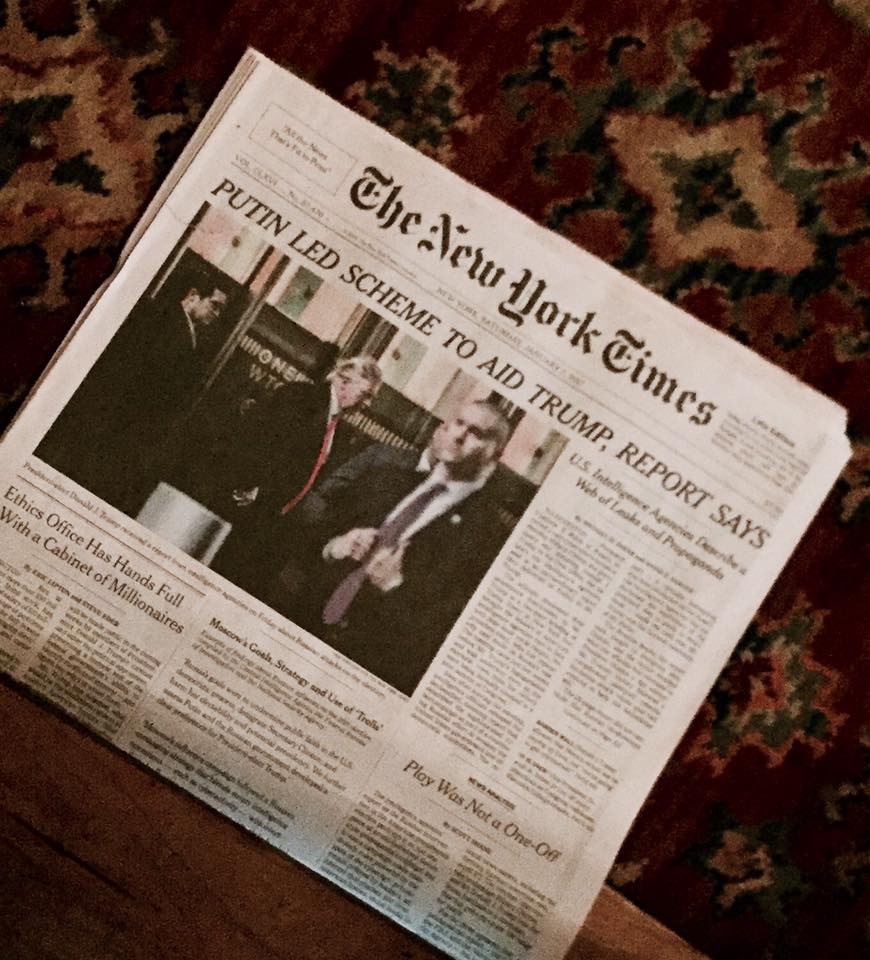
Putin led scheme to aid Trump —NYT

15940537_1209722709107796_7956175523737667264_n

I’d already seen the FT’s version of this headline on my phone before opening my hotel door early this afternoon. In fact, I’d managed to incorporate the 25-page ‘intelligence report’ into my hangover-recovery ritual.

Having been dragged wide-eyed and open-mouthed through the unrestrained politicisation of intelligence dossiers in the lead up to the Second Gulf War, this contrived establishment soliloquy was only too familiar.

The Olympian effort to bind together the Clinton campaign’s favourite bogeymen—Trump and Putin—is clearly not going to end gracefully. In the meantime, I think the US establishment is making a grave error in its decision to continue trying to manage public opinion by attempting to inflict a Carthaginian peace upon its populist upstart adversaries.

The hacked emails were received and published by Wikileaks. If there’s an agenda behind their publication, isn’t it reasonable to consider whether it might have been Wikileaks’ agenda? Apparently not, given that there’s no mention of Wikileaks’ own agenda throughout the report. That doesn’t warrant a thought, it seems: all we need to know is that its publication served Putin’s agenda.

It’s also unworthy of any mention that the information was true, and gave the public a unique insight into what the senior Clinton campaign managers say to each other behind the public’s back. Information that democracy purists might even suggest would enhance the democratic process. Certainly, the Clinton campaign worked indefatigably to reveal behind-the-scenes insight into their opponent’s world. But that’s just not relevant, apparently: Revealing to the public accurate information about what the Clinton campaign says to itself served only—according to the intelligence report—to ‘denigrate Secretary Clinton, and hurt her electability’.

I mean… seriously? If the goal here is to diminish Trump’s chances of a second term, these dealers need to relearn their poker.

♠️

The new role for business in a fairer Britain

Mrs May, in a surprise contribution to Sunday’s FT (https://www.ft.com/con…/12a839d4-af18-11e6-a37c-f4a01f1b0fa1), enjoined businesses to work together with government to, I quote: ‘maintain confidence in a system that has delivered unprecedented levels of wealth and opportunity, lifted millions out of poverty around the world, brought nations closer together, improved standards of living and consumer choice, and underpinned the rules-based international system that has been key to global prosperity and security for so long…’

She’s referring, of course, to free market capitalism. Or, more pointedly, to combating what she perceives as voters’ loss of confidence in the system. Voters are, she worries, resentful of unequal distribution of wealth, and perhaps perceive a rigged establishment with tax-avoiding corporations, tax-avoiding non-dom shareholders, and stratospheric financial sector bonuses awarded for taking risks that are underwritten by the taxpayer. Fair enough: they’re all good reasons for voters to be unhappy.

Except, how unhappy are they? Are voters really losing confidence in the system?

May is reading the electorate’s mood through the prism of Brexit. She will likely always be condemned to do so. For Mrs May, Brexit is the drug from Plato’s Pharmacy: a poison that paralysed the establishment, yet a remedy for her ambition to ascend the establishment’s most senior office. Through this lens, the referendum, Trump, the resurgence of populist politics across the Western hemisphere, represent iconoclastic, anti-establishment movements.

Which, in fact, they’re not. Voters still aren’t much interested in politics and economics. The anti-establishment theme is almost accidental. Voters are just having an identity crisis.